

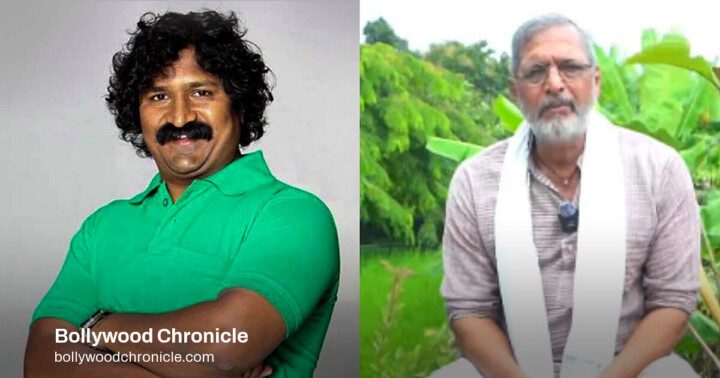
At Nana Patekar’s last rites in Donje village near Pune, the people who came were not the ones usually photographed at a film funeral. Farmers, villagers, political figures and a few performers gathered to say goodbye. Marathi filmmaker Pravin Tarde, who was present, has now asked why so many of the actor’s colleagues in Hindi cinema did not.
A death and a homecoming
Patekar died on October 8 in Goa at the age of 75 following an acute heart attack. His remains were brought to his native village of Donje, where his last rites were performed at his farmhouse on Thursday night. His son Malhar, other family members and villagers were present.
Tarde’s public complaint
Speaking to ABP Majha, Tarde said farmers and political figures were present, while film industry faces were few. He named Jackie Shroff and Suresh Wadkar among the exceptions.
He framed the farmers as the more meaningful presence. Tarde said “a farmer who came from Dhule is much greater than Bollywood heroes,” and added: “Nana always used to say that he was a farmer.”
He also contrasted the scene with the usual Mumbai response to a lesser-known actor’s death. When a small-time actor dies, he said, “people line up wearing white clothes.” For Patekar, he said, the farmers were there instead.
The record of a farewell
- Who came: farmers from Dhule and other villages, political figures, villagers and family members gathered for the antim darshan.
- Who did not: Tarde said Bollywood’s turnout was thin, beyond Jackie Shroff and Suresh Wadkar.
- What he said: the absence did not reduce Patekar’s stature, but it left a complaint about friendship and obligation.
Why it matters
Patekar’s career spanned decades and earned recognition across Indian cinema. Yet the funeral in Donje underlined what he often said himself—that his identity was not confined to the film industry. Tarde’s criticism is not just about who missed a ceremony; it is about how Hindi cinema marks the passing of its own, and how it fails to, when the person never played the industry’s social game.
For readers who follow Hindi cinema closely, the moment lands as a memory question: which audiences actually carry a performer, and which ones only claim him afterwards.
Source: Moneycontrol

Comments