

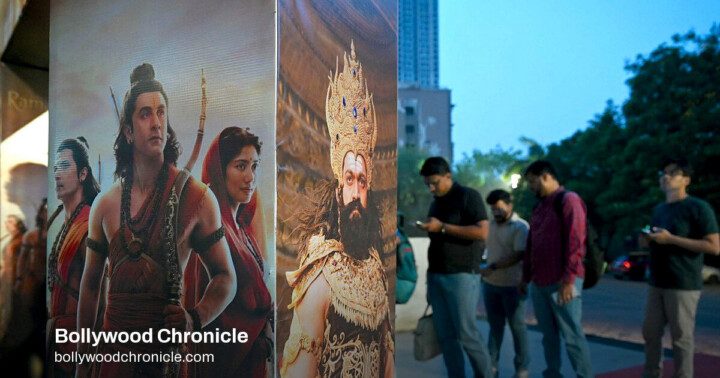
Ramayana: Rise of a Legend, starring Ranbir Kapoor, opened in Indian cinemas on 5 November, two days before Deepavali. Industry experts estimate the budget at $420 million, making it the most expensive project in Indian cinema history. The film is conceived as the first entry in a two-part series.
The production premiered in Los Angeles last week and arrives with nearly 40 dubbed languages. Director Nitesh Tiwari has said artificial intelligence was used to synchronise lip movements with translated scripts, a logistical choice that matters when an epic travels to this many markets at once.
Why this adaptation carries weight
The Ramayana is not conventional intellectual property. Attributed to the Sanskrit poet Valmiki, it tells of Prince Ram’s exile, the abduction of Sita by Ravana, and the rescue aided by Lakshman and Hanuman. Hindus widely revere Ram as an incarnation of Vishnu, and the story has been retold for centuries across South and Southeast Asia.
In modern India, the epic became tied to the Ayodhya temple campaign. A 16th-century mosque stood on a site many believe was Ram’s birthplace. The dispute became a political flashpoint in the late 1980s and early 1990s. A mob demolished the mosque in 1992, riots killed about 2,000 people, and the Supreme Court awarded the land for a temple in 2019; Prime Minister Narendra Modi inaugurated the temple in 2024.
The screen-memory factor
For many viewers, the strongest reference point is still the state-run Doordarshan serial of the late 1980s. Millions watched weekly as visual depictions of Ram were relatively rare, and the broadcast often took on devotional character. Some scholars argue the series strengthened the then-nascent Hindu nationalist movement: the BJP grew from two Lok Sabha seats in 1984 to 120 in 1991 as Ayodhya became a national issue.
The epic also extends well beyond Hindi cinema. Retellings exist in Tamil, Bengali, Thai, Khmer and Indonesian, and its stories appear in dance, theatre and shadow puppetry in Thailand, Cambodia and Indonesia. It frames Dussehra and Deepavali, which is widely linked to Ram’s return to Ayodhya.
What a close reader should track
- The two-part gamble: this is the opening of a planned diptych, so the real question is the arc it establishes, not the first weekend alone.
- The dubbing experiment: nearly 40 language versions, with AI-synced lip movements, will test whether a devotional story can hold its tone at scale.
- The global comparison: the film has already been likened to Christopher Nolan’s The Odyssey, a benchmark that raises pressure on spectacle and storytelling.
The release is therefore more than a box-office event. It is a measure of how far a sacred and politically charged Indian story can be financed, marketed and translated for audiences who bring very different kinds of memory to the same title.
Source: The Star
Comments