

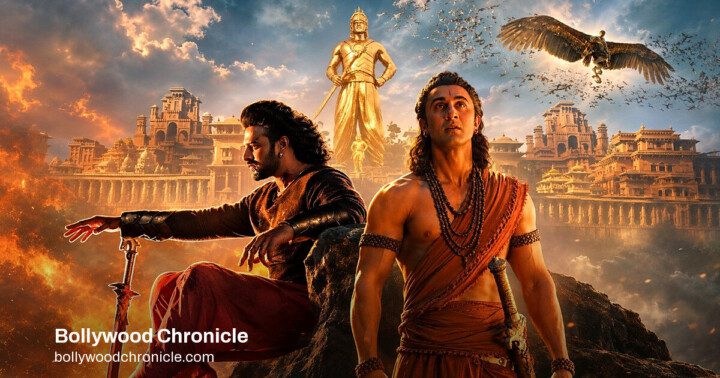
Nitesh Tiwari’s Ramayana, produced by Namit Malhotra, arrived in theatres after one of the most unforgiving visual-effects trials Indian cinema has seen. Early promotional clips were examined frame by frame, with audiences hunting for green-screen halos and dismissing some footage as AI-generated. By the time the film reached screens, it had answered much of that scepticism—even if not every element worked equally well.
What the early footage got wrong
The pre-release complaints were specific: unnatural skies, flat colour grading, and Asuras that looked unfinished. Ranbir Kapoor pushed back, saying the images represented years of artists’ work rather than a single click. Namit Malhotra made a related argument: a film designed for IMAX should not be judged on compressed phone clips.
Theatrically, that defence was largely borne out. Digital elements sat more naturally in the frame, though the Asuras remained a weak spot. The distance between trailer and finished film is worth remembering: much of this work continues until release, and promotional cuts rarely tell the full story.
Why Baahubali is still the reference point
Indian cinema has been working with visual effects for decades, from double roles to multiplied crowds. But Baahubali: The Beginning raised the game because it made the effects cohere into Mahishmati, a world audiences could believe in. It was not about the most effects; it was about the right effects for the story.
- Enthiran (2010) and Ra.One (2011) tested robots and superheroes but let effects outrun story.
- Baahubali made digital palaces, multiplied crowds and creatures feel like one believable kingdom.
- RRR turned a digital animal sequence into a dramatic payoff rather than a showreel.
- Adipurush became the cautionary example; Hanu-Man, made on a reported Rs 40 crore budget, showed that strong art direction can beat bigger spends.
Later experiments widened the range: Brahmastra Part One pushed elemental particle simulations, and Kalki 2898 AD built a dystopian Kasi around a practical, CGI-enhanced vehicle. Both moved Indian cinema closer to global scale, even when some green-screen moments felt flat.
Money can buy talent, render time and scale; it does not automatically buy taste.
What Ramayana got right, and what still lags
Backed by DNEG, an eight-time Academy Award-winning visual effects studio, Ramayana used physical sets with digital extensions, actor scanning and environmental work. That gave artists real light, texture and scale to build around—something a fully pixel-made world struggles to match. Jatayu was the clearest test: the giant bird needed believable weight, wind-responsive feathers and expressions that carried pain and courage.
Yet the praise for the film’s scale still runs ahead of its emotional pull. That gap is where Baahubali remains untouched. Rajamouli used VFX selectively and let emotion carry the big moments; the statue lift lands because the audience already understands the power it represents. The next challenge for Ramayana, and for Indian cinema, is not a bigger kingdom or another thousand soldiers. It is making the ambition felt. Audiences do not leave the theatre tallying effects shots; they leave remembering Jatayu falling, or a statue rising, with a reaction that belongs to the story.
Source: India Today

Comments