

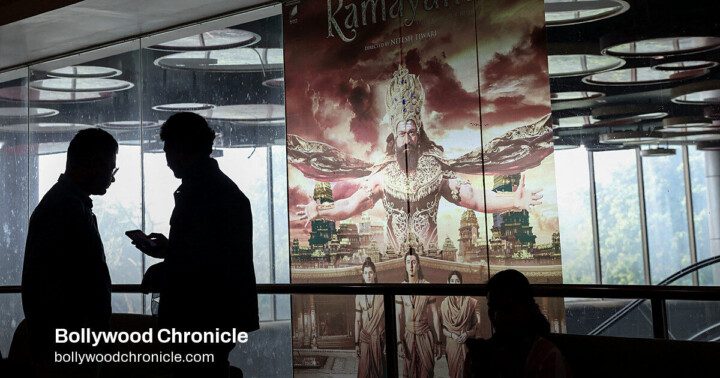
Ramayana: Rise of a Legend has passed the $100 million mark at the global box office, with $67 million of that coming from India, according to Fortune. The first half of a two-part adaptation of the ancient Sanskrit epic is the most expensive Indian film ever made, with a reported budget of ₹40 billion ($420 million).
The film opened worldwide on November 5 and in the U.S. on November 6. Its opening weekend brought in $55.7 million globally, and it later became the first Indian film to top the U.K. box office. On Rotten Tomatoes, it holds a 77% critic score and a 94% audience score.
Why this is more than a box-office report
The release is a deliberate crossover test. In the U.S., audiences can choose between the original Hindi cut, which runs three hours and fifteen minutes, and an English-dubbed version that is about thirty minutes shorter, with musical sequences removed and other scenes trimmed. That structure lets the producers test whether tighter, localised storytelling widens the audience beyond the Indian diaspora.
Indian films have travelled before, often in markets with little or no diaspora. Tejaswini Ganti of New York University points to Awara (1951), Aan (1952) and Mother India (1957) as early international successes. Disco Dancer (1982) and Mard (1985) later played strongly in the Soviet Union and West Africa, while diaspora favourites such as Dilwale Dulhania Le Jayenge (1995) and Kal Ho Naa Ho (2003) built a different kind of reach. More recently, Dangal grossed more than $190 million in China and Secret Superstar took $117.7 million there.
Producer Namit Malhotra has framed the ambition in continuity with the source: “For generations, the Ramayana has inspired people through its timeless humanity and enduring values.”
What to watch
- The arithmetic: A $100 million-plus global gross is strong, but the film carries a reported $420 million budget across two parts, so the second instalment and ancillary legs matter.
- The two-cut experiment: A full Hindi version and a shorter English dub are effectively separate products in the same market.
- The AI conversation: Promotional material credits “Brahma AI” with helping create nearly 40 language versions; director Nitesh Tiwari says it was used only for lip-sync.
- The critical split: Praise for visuals and performances is being weighed against complaints about pacing, score and CGI.
The AI question may determine the legacy
Even before the box-office run, the film’s reported use of AI became part of the story. A promotional video says “Brahma AI” was used to bring different language versions to screen, with the film reportedly dubbed into nearly 40 languages. At the premiere, Tiwari said dialogue and character voices were recorded by human performers, and that AI was used “only to get the lip-sync” for localised versions. Some U.S. critics remain unconvinced; IGN’s review called out “awkward AI lip-syncing” in an otherwise ambitious Part 1.
The result is a kind of stress test for Indian cinema’s international ambitions. The global total will be watched less as a verdict than as a signal: whether a story so central to Indian tradition can be packaged into the global fantasy marketplace without losing its identity.
Source: Fortune

Comments