

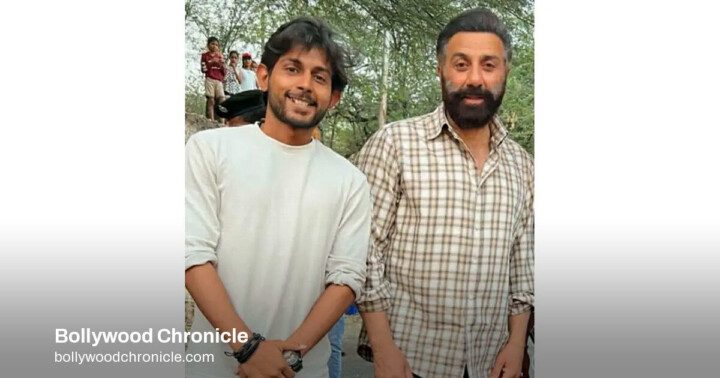
For Hindi cinema, a dance number usually announces itself with a stage, a chorus and room to move. On the upcoming film Suryaa, choreographer Viraj Pandya had a different assignment: create rhythm inside a car, with two actors seated and the emotional truth of the scene doing much of the dance.
Pandya assisted director-choreographer Rajeev Surti on the film, which stars Sunny Deol and Ravi Kishan and is set against a backdrop that evokes 1990s Hindi cinema. The dance sequences featuring the two actors are built less on spectacle than on small, character-anchored gestures.
A stage the size of a car seat
The brief, as Pandya describes it, was to make even the smallest moment visually engaging and in sync with the music. An exchange of a glass, the way an actor shifts in the seat, a pause that lands on a beat: these are the movements that carry the choreography. The car becomes the performance space, and the scene’s logic becomes the real choreographer.
That is a meaningful distinction. A stage number can hide a weak dramatic beat behind movement. A seated sequence cannot; if the gesture is false, the audience notices. Pandya says freestyle choreography in cinema operates with creative limits because every movement has to answer to character and situation.
The drunk-man sequence as a craft problem
One moment in Suryaa makes the stakes clear. Sunny Deol portrays a drunk man missing his wife. The challenge is not to make the actor dance; it is to make his condition legible without becoming theatrical or disappearing into stillness.
This is a balancing problem as much as a dance problem. The movement should communicate grief and intoxication, but it must not become exaggerated or understated. For a choreographer, that is an education in editing your own work: the strongest choice is often the one you hold back.
Pandya also frames the project as a learning experience. Assisting Rajeev Surti gave him a close view of the finer nuances of film choreography: how a gesture is placed, how a beat is respected and how a performer’s physicality is shaped around a scene, rather than the scene around the dancer.
Why the 90s register still matters
Hindi cinema has long used song as an extension of drama. The 1990s setting of Suryaa is not merely decorative; it suggests a mode where the song had to carry feeling and plot, not just production value.
What the film appears to be attempting is a return to that texture: sequences that read as moments of character with a rhythm, rather than detachable music videos inserted into the narrative. If it works, the audience will feel the beat without noticing the machinery.
- Character first: every movement is tested against who the actor is playing.
- Situation sets scale: a song inside a car cannot borrow the language of a stage.
- Gestures replace steps: an exchanged glass or a timed pause can carry the musical idea.
What to watch for
For close followers of Hindi cinema, Suryaa will be a small test of whether restrained, situation-led choreography can still command attention alongside today’s larger dance productions. The early signal from Pandya is that the team is choosing character over spectacle, and asking the audience to do the same.
Source: Mid-Day

Comments