

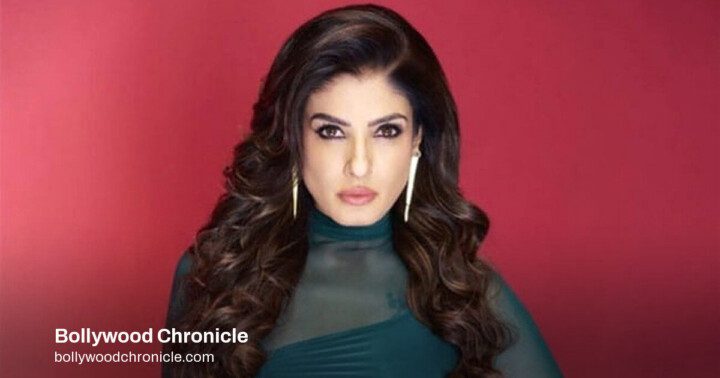
Raveena Tandon turns 54 on 26 October, an occasion to read her entry into Hindi cinema as a longer and less linear story than the usual launch narrative. The actor, who became one of the most recognisable faces of 1990s commercial cinema, began behind the camera rather than in front of it.
An accidental start
Despite being the daughter of filmmaker Ravi Tandon, Raveena has said that acting was never a planned destination. After Class 10, she assisted ad filmmaker Prahlad Kakkar and did unglamorous production work, including cleaning studio floors. When a model failed to arrive, she was often asked to step in front of the camera; the repeated favour turned into a small business idea: modelling could earn pocket money.
In a 2022 interview with Mid-Day, she described that origin: “I am in this industry actually by default.”
The films she said no to
Modelling brought film offers, but Raveena was not immediately persuaded. Speaking on ANI’s podcast in 2023, she recalled that Yash Chopra’s Darr, later a landmark for Shah Rukh Khan, was offered to her first. She clarified that the film was not vulgar, but it asked for costume scenes she was not willing to do.
Other offers met a similar response:
- Prem Qaidi, which later became Karisma Kapoor’s debut, was refused over a scene she was not comfortable with.
- Phool Aur Kaante, Ajay Devgn’s debut, was rejected because she was not sure she wanted to act at all.
Those refusals have become a recurring what-if in Hindi cinema because two of the films launched actors who came to define the decade. But the pattern is also the point: before she had a filmography, Raveena was drawing boundaries around what she would and would not do on screen.
Patthar Ke Phool and after
The route to Patthar Ke Phool (1991) was similarly informal. Friend and fellow model Bunty Walia called Salman Khan, who was looking for a fresh face, and asked him to consider her. She has credited the meeting, and the film, to destiny.
The debut opposite Salman Khan won her the Filmfare Award for Best Female Debut and began a run that included Mohra, Dilwale, Andaz Apna Apna and Dulhe Raja. Her pairing with Akshay Kumar after Mohra became a fan favourite on the strength of songs such as Tip Tip Barsa Paani and Tu Cheez Badi Hai Mast Mast; their off-screen engagement later ended.
More serious work followed. Her performance in Daman: A Victim of Marital Violence won the National Film Award for Best Actor (Female) in 2002, and her comic pairing with Govinda in Dulhe Raja, Anari No. 1 and Bade Miyan Chote Miyan gave her another durable register. After breaks, she returned through South Indian projects such as Akasa Veedhilo, Sadhu and Aalavandhan, as well as KGF: Chapter 2, then reached a new set of viewers with Netflix’s Aranyak.
Why the early refusals matter
Raveena’s story is useful context for the way stardom is often rewritten as inevitability. The more interesting record is of an actor who entered the industry “by default,” refused major titles on her own terms, and still built a career long enough to span 1990s stardom, a National Award and the streaming era. For anyone charting a creative career, the sequence is a reminder that early noes can be as defining as the first yes.
Source: Hindustan Times
Comments