

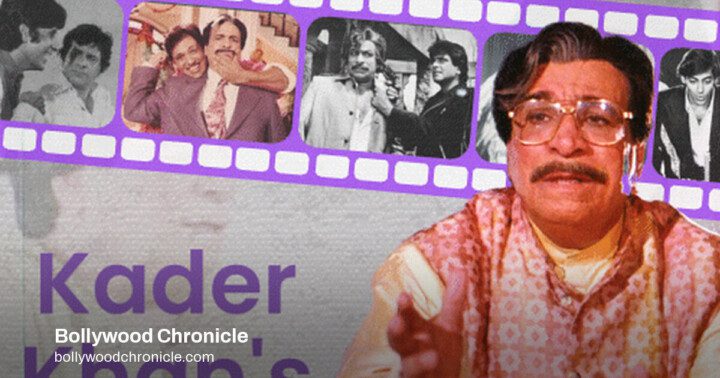
Some of Hindi cinema’s most quoted exchanges were shot on Amitabh Bachchan but built with Kader Khan’s pen. On his birth anniversary, that pen deserves to be remembered as more than a piece of trivia. Kader Khan, born in Kabul on 22 October 1937, wrote dialogues for more than 250 films and acted in around 300 — but the route to those credits began with hunger, a graveyard, and a mother who refused to let him quit school.
The road from Kamathipura
Kader Khan was born into a family already marked by loss. Three older brothers died young, and his mother insisted on leaving Afghanistan. The family arrived in Bombay with little money and settled in Kamathipura. When his father left to serve as an imam and his mother’s second marriage collapsed, hunger became routine. Kader sometimes walked to a mosque in Dongri to ask his father for ₹2; when that failed, he begged outside the mosque.
His mother changed the trajectory. When neighbourhood boys urged him to leave school for a factory job paying ₹4–5, she stopped him and told him to stay in class. He completed matriculation and later taught at M.H. Saboo Siddik College of Engineering in Byculla. At about eight, his habit of reciting film dialogues in a cemetery had already caught the attention of theatre performer Ashraf Khan — the first door into theatre.
A three-hour script and a star phone call
Theatre opened the film door. After Narendra Bedi and Kamini Kaushal saw his play Local Train, Bedi asked him to write dialogues for Jawani Diwani. Kader took a local train to Marine Drive and returned three hours later with a finished draft, earning ₹1,500. He would reportedly be paid ₹1,21,000 for Roti‘s dialogues in 1974.
Dilip Kumar came to see him after Agha’s recommendation. When the call reached his classroom, Kader did not know the ‘Yusuf’ on the line was the industry’s Dilip Kumar. That meeting brought roles in Sagina and Bairaag; his first screen credit as an actor was the lawyer in Daag (1973).
Why the writer matters
Kader Khan’s filmography includes Amar Akbar Anthony, Muqaddar Ka Sikandar, Sharaabi, Coolie, Laawaris, Satte Pe Satta and Agneepath — films whose lines audiences still repeat. Yet the public memory of Hindi cinema often stops at the face on screen. His story is a reminder that the star’s voice was frequently assembled on the writer’s page.
- More than 250 films with dialogue credits, around 300 acting roles
- Filmfare Awards for Best Dialogue: Meri Awaaz Suno (1982) and Angaar (1993)
- Best Comedian for Baap Numbri Beta Dus Numbri, a film he wrote himself
- Posthumous Padma Shri in 2019; he died in Canada in December 2018 at 81
The ‘Sir’ fracture
Even his professional friendship with Amitabh Bachchan carried the asymmetry of stardom. After collaborating on Coolie and Suhaag, Kader reportedly objected when a producer insisted he address Bachchan as ‘Sir’ rather than Amit. Kader later said Bachchan also wanted the title. The disagreement, by his account, strained the friendship. The episode captures a recurring tension in film industries: the writer may supply the voice, but the star gets the address.
Source: Bhaskar English


Comments