

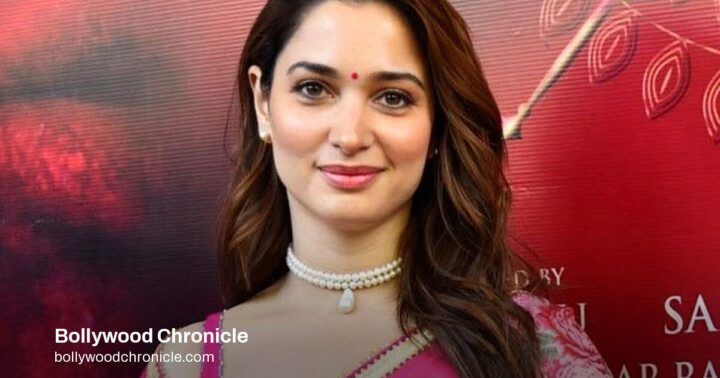
Tamannaah Bhatia’s Hindi film career began with a failure. Her 2005 debut Chand Sa Roshan Chehra came and went, and the teenage actor found no foothold in Mumbai. Instead of waiting, she moved to Tamil and Telugu cinema, where the language and working cultures were unfamiliar, and began the long, uneven route that would eventually make her a pan-India name.
The long game begins in the South
After the debut flop, Bhatia appeared in the Telugu film Sri (2005) and the Tamil film Kedi (2006). Her early years were not a straight line: she has said she was once told she moved like a boy and needed more flexibility in her dancing. She responded by working harder rather than retreating.
By 2007, Happy Days in Telugu and Kalloori in Tamil gave her traction with younger audiences. Ayan (2009) and 100 Percent Love (2011) consolidated her place, even as other releases underperformed.
Drawing a line without raising her voice
The most consequential early test came when she objected to a scene she was uncomfortable doing. In a conversation with The Lallantop’s Newsroom, Bhatia recalled that someone on set responded by saying, “Replace the heroine.” She stayed with her decision.
For Bhatia, the episode became a template: protecting a boundary does not require aggression. She has said that people who questioned the decision later respected her for holding her ground, a principle she carried across an industry where younger actors often have little leverage.
Baahubali as a reset
By the time S.S. Rajamouli’s Baahubali: The Beginning arrived in 2015, Bhatia had spent a decade building a South Indian career. Playing Avanthika introduced her to audiences who had never seen her Tamil and Telugu work. The sequel in 2017 reinforced the shift: she was now a nationally recognised actor rather than a regional lead.
Her Hindi visibility got another boost with Aaj Ki Raat from Stree 2. Bhatia rehearsed for around 15 to 20 days, and choreographer Vijay Ganguly shaped the movement around her strengths; in 2026, the song won him the National Film Award for Best Choreography.
The metric that matters
Bhatia has reframed what a durable career means. The hard part, she says, is not making a film work; it is returning to the set after every up and down. Success is the next opportunity.
- Early failures: Chand Sa Roshan Chehra flopped, and later titles such as Himmatwala and Humshakals raised doubts about her Bollywood prospects.
- Turning points: Happy Days, Kalloori, Ayan and 100 Percent Love built her South Indian base; Baahubali made her pan-India.
- Current phase: Aaj Ki Raat returned her to Hindi audiences, and her recent One – Force of the Forest is drawing a festival-like response in theatres.
She puts her current stance plainly: “I do not feel bound by any kind of box today. I feel I can play any kind of role.” That freedom, she says, comes from audiences accepting her across different registers rather than fixing her to one image.
The takeaway for actors and creators is small and difficult: keep showing up, treat each rejection as data, and measure longevity by the next offer rather than the last result. Bhatia’s two-decade record suggests that the quiet skill of staying in the game is often rarer than a single opening weekend.
Source: Bhaskar English
Comments