

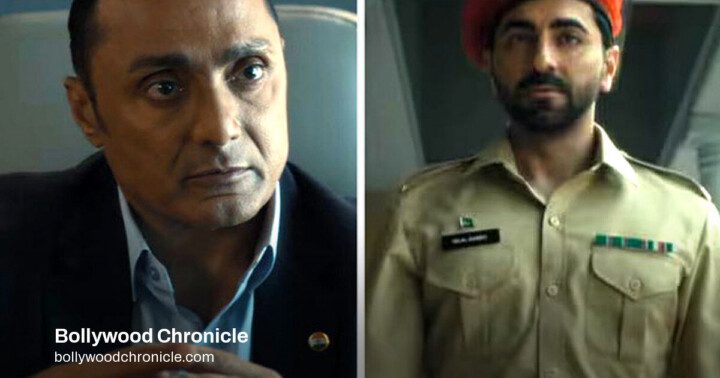
Rahul Bose built a career on restraint. In Udta Teer, that restraint becomes the joke. He plays M D Burman, head of the Counter Terrorism Squad, who pieces together that Ayushmann Khurrana’s protagonist is a Pakistani spy and then slips into a coma. For the rest of the film, Bose’s character communicates through his eyes and body, while the spy loses his memory and starts believing he is an Indian patriot.
The part is a wordless physical comedy that the actor, in conversation with Bollywood Hungama, called “almost mime.” It is also a deliberate act of casting against expectation.
Casting against type was the point
Bose asked writer-director Aakash A Kaushik why he would cast him. The answer was that no one would expect the film to turn funny. The character arrives as a serious CTS chief, close to Bose’s Berlin persona, so the turn lands as a surprise. A known comedy actor would have signalled the shift in advance, the director reasoned.
Kaushik also remembered watching Bose on a game show where contestants had to convince the audience they were truthful. Bose won while lying the whole time. That, the director felt, meant he could carry a performance in which the eyes do the talking.
The trailer withheld the payoff
Bose’s funniest scenes were largely kept out of the promotional edit. Friends asked whether his role had been cut: “Tumhara role kat gaya kya?” He told them to watch the film, then admitted that sounded like something a loser would say. The feedback has since vindicated the strategy: not showing him was a good decision.
From the glorious heights of Mr & Mrs Iyer, I have now become a slapstick comedian. This is on you!
He said the line to Kaushik, referencing the 2002 film that helped define his serious image.
A thin script became a physical performance
Several of the biggest gags were not in the script. The page simply said that Ayushmann saves Rahul in hospital. What happens on the bed, with the defibrillator pads, with his legs, who gets hit and where bodies fall were improvised. The morgue kiss was written; the lift door banging on his head ten times was not, and was designed by the action director with comedy in mind.
Bose said he tried to change his expression on every single take. The reliable test was the unit: if the crew, who already knew the shot, still laughed on the third, fourth or eighteenth take, the material was working.
The film’s romantic strain also grew beyond the script. The director’s outline said Holkar, played by Smita Tambe, loved Bose’s character; the reactions, the development and the wheelchair rose were worked out during production.
Why the risk worked
- Casting against type kept the comic turn from being telegraphed.
- Withholding Bose from the trailer turned the reveal into a word-of-mouth asset.
- Improvisation gave the slim comic scenes the detail that audiences responded to.
Bose was not new to physical comedy. He began doing it on stage in 1990, 36 years ago. But in cinema, the register was different. He said he would not have taken the part if Kaushik had not assured him this was a sustained performance rather than a one-scene cameo; after the rough cut, the director expanded the role.
Some viewers told Bose they had seen him in Bulbbul and now could not reconcile the two performances. That confusion, earned through craft rather than a single joke, is the response the film wanted.
The film has also revived a conversation about promotional restraint. Keeping the best comic set pieces out of a trailer is a risk, but Udta Teer has framed it as a choice about surprise rather than omission.
Source: bollywoodHungama.com



Comments