


Nana Patekar, the actor who redefined what screen anger could sound like in Hindi cinema, died on Thursday after a sudden cardiac arrest. Over a career lasting more than four decades, the three-time National Award and four-time Filmfare winner introduced a local, colloquial fury that felt borrowed from the street rather than built in a studio.
A different register of rage
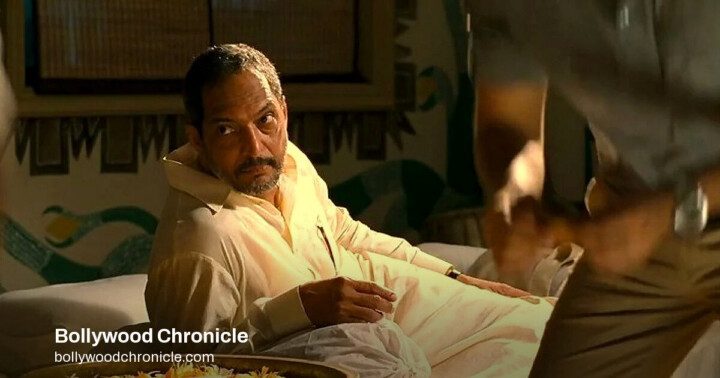
Before Patekar’s breakthrough in the late 1980s, anger in mainstream Hindi film often arrived in a stylised, larger-than-life package. Patekar stripped that artifice away. His rage was quick, unpredictable and intensely local — the frustration of an ordinary citizen, not a star’s pose. It showed in N. Chandra’s Ankush, in the wounded gangster Anna Seth in Parinda, and in the secular fury of Krantiveer.
He did not pretend that heroes were clean or villains were simply evil. As he put it, “To me, a villain also has a bright side and a hero also has grey shades.” That conviction meant many of his characters remained legible long after their plots had dated.
From theatre to screen
Patekar was born on January 1, 1951 in Raigad district, Maharashtra. Family hardship pushed him toward painting posters and billboards, then to JJ School of Arts and inter-collegiate theatre. Vijaya Mehta cast him in Marathi productions including Hamidabai Chi Kothi and Purush, where his stage intensity drew notice. Smita Patil encouraged him toward Hindi cinema after seeing his work in Simhasan.
The turn came with Ankush in 1986, but Parinda made him a national name. Vidhu Vinod Chopra’s film gave him the underworld figure Anna Seth, a menacing yet frightened man whose vulnerability made the violence more disturbing. That performance brought his first National Film Award.
He then refused to stay in one lane. In Thoda Sa Roomani Ho Jayen he played with a gentle, lyrical register; in Khamoshi: The Musical he carried scenes through silence and sign language. For Prahaar, which he also directed, he did not fake the army experience and went through Territorial Army training. His shooting practice shaped the restrained lethality of Sadhu Agashe in Ab Tak Chhappan.
Defiance, pragmatism, and a long shadow
His filmography can be read as a journey from the defiance of late-eighties and nineties cinema — Ankush, Prahaar, Wajood — to something closer to institutional exhaustion in the 2000s, in films such as Ab Tak Chhappan, Apaharan and Raajneeti. In Welcome he inverted his own intensity for comedy, and in Natsamrat he returned to Marathi theatre’s emotional grammar with one of the most affecting passages of contemporary Indian cinema. The Padma Shri recipient held his own against Amitabh Bachchan, Rajinikanth and Shah Rukh Khan, and moved between the politics of Prakash Jha and the poetics of Sanjay Leela Bhansali.
- Late 1980s–90s: Ankush, Parinda, Prahaar, Krantiveer, Yeshwant — defiance and the man on the street.
- 2000s onwards: Ab Tak Chhappan, Apaharan, Raajneeti — pragmatism and institutional fatigue.
- The later stretch: Natsamrat, Welcome, The Real Hero, Sankalp — range beyond the angry image.
Off screen, Patekar co-founded Naam Foundation with Makarand Anaspure to support drought-hit farmers in Maharashtra. But his legacy is not untroubled. At the start of India’s #MeToo movement, Tanushree Dutta accused him of sexual harassment on the set of Horn Ok Please. He denied the claim, and Mumbai Police found the evidence insufficient to prosecute or substantiate the allegations, but the public image of the hot-tempered maverick was re-examined in a colder light.
Source: The Hindu


Comments