

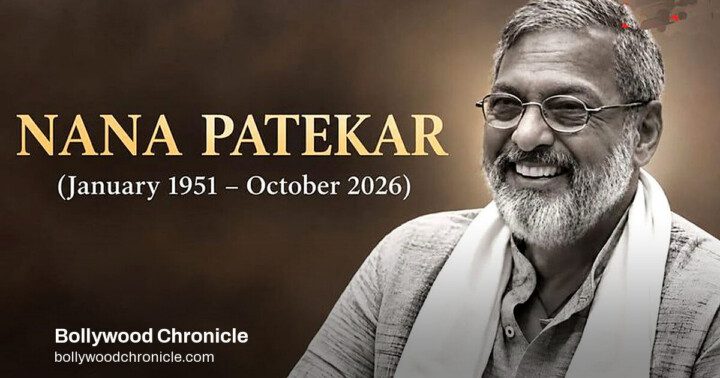
Nana Patekar, whose voice and stare made Hindi cinema feel more dangerous and more truthful, died on Thursday, October 8, 2026, at his residence in Goa. He was 75. His son Malhar Patekar confirmed the news.
Patekar had complained of feeling unwell in the early hours and was later found unresponsive at home. He was taken to Manipal Hospital in Goa, where doctors tried to revive him for around 45 minutes. A post-mortem was ordered as part of official procedure.
A stage actor first
Born Vishwanath Patekar in Maharashtra in 1951, he came to cinema through theatre, and it showed. His Hindi film debut with Gaman arrived in 1978, but the breakthrough performances came with Parinda and Krantiveer. Mira Nair’s Salaam Bombay! carried his craft to international audiences. Across nearly five decades he moved between serious cinema and mainstream Bollywood, between dramatic and comic roles, without ever sounding like anyone else.
Intensity as a range, not a mood
What set Patekar apart was his ability to use intensity as a tool rather than a fixed register. He could be menacing in a drama and then pivot to the deadpan comedy of Welcome. Natsamrat returned him to the stage-trained tragedy that formed him. The official record makes the span clear:
- Three National Film Awards.
- The Padma Shri, one of India’s highest civilian honours.
- A career across Hindi and Marathi cinema, theatre and filmmaking.
The three National Film Awards are not a small detail. They place him in a small group of actors whose work was recognised across categories and decades. The Padma Shri underlines that his influence travelled beyond box-office arithmetic.
“intensity, individuality and unmistakable presence” — Prime Minister Narendra Modi
Prime Minister Narendra Modi described him in those terms and said his contribution to Hindi and Marathi cinema was immense. Tributes followed from across the film industry and political circles.
What the record should remember
For readers who keep the record of Hindi cinema, the details matter. Patekar carried the grammar of post-independence theatre into mainstream film without softening it. He was also known for his straightforward personality and outspoken views, which kept him distinct from the managed persona of the conventional Bollywood star.
His loss arrives at a moment when Hindi cinema is once again debating what screen acting should be. Patekar belonged to a generation that trusted language, timing and silence more than technique. His performances are not just remembered; they are studied. That is why a cardiac arrest in Goa feels like the closing of an entire index, not just the end of one career.
His last rites will be performed in Pune with full state honours. The films remain, as does the need to remember what acting without camouflage looks like. The record now closes with the same certainty he brought to a scene: 1951–2026.
Source: Daily Excelsior


Comments