

A record before the release
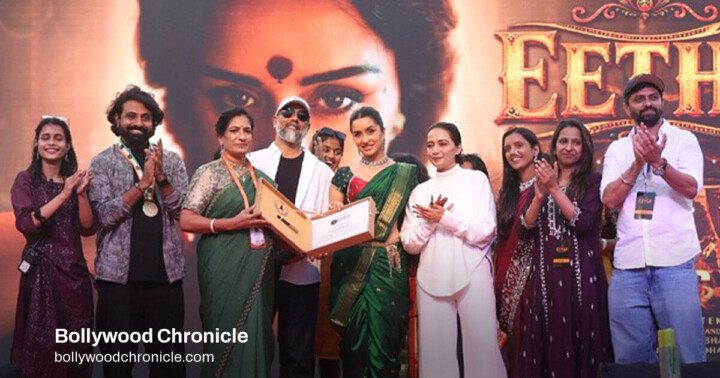
Eetha, starring Shraddha Kapoor and directed by Laxman Utekar, has earned entries in the India Book of Records and Asia Book of Records ahead of its theatrical release. On November 24, 2025, at Zeal University in Pune, 517 women from different age groups performed the hook steps of the film’s first song, “Ji Ji Re Ji”, in synchrony for one minute.
Officials from the Asia Book of Records witnessed the attempt. After the performance, certificates and gold medals were presented to Shraddha Kapoor, Laxman Utekar, and representatives of Maddock Films and Kathputli Creations.
Produced by Dinesh Vijan, Laxman Utekar and Karishma Sharma under the banners of Maddock Films and Kathputli Creations, Eetha has turned a pre-release song into a certified public event.
Why Lavani carries this campaign
The song, released on November 17, is composed by Ajay-Atul, sung by Shreya Ghoshal and Ajay Gogavale, written by Amitabh Bhattacharya, and choreographed by Vaibhavi Merchant. The sequence recreates an important episode from the life of Vithabai, the celebrated Lavani performer, including the incident in which she performed on stage during pregnancy and went into labour.
That frame matters. Lavani is not set dressing here; it is the film’s language. A record built on synchronised Lavani hook steps gives the campaign a cultural centre, and it turns a song release into an event that women from different age groups could physically join.
The promotional logic
Record-style activation is an old Hindi cinema tool with a new precision. It gives a pre-release song a measurable achievement, an official certificate, and a visual of scale. For Eetha, the feat also gives Lavani a larger audience through a collective performance.
- 517 women performed in sync for one minute.
- The attempt was witnessed by Asia Book of Records officials.
- The film entered the India and Asia record books before release.
That is a useful promotional loop: learn the hook step, join the record, share the film’s defining movement. The risk, familiar to folk forms borrowed by mainstream cinema, is that the tradition becomes a one-minute prop rather than a sustained point of view.
What this sets up
For the audience that follows Hindi cinema’s history, Eetha’s record is significant because it connects a commercial campaign to a named Lavani performer and a specific biographical episode, not merely to a dance trend. The record also puts the song’s choreography in front of audiences who may not know Vithabai’s story yet.
The next test is whether the film releases with that context intact. The record has already done its job: it gives the campaign a headline before the first review.
Source: bollywoodHungama.com


Comments