

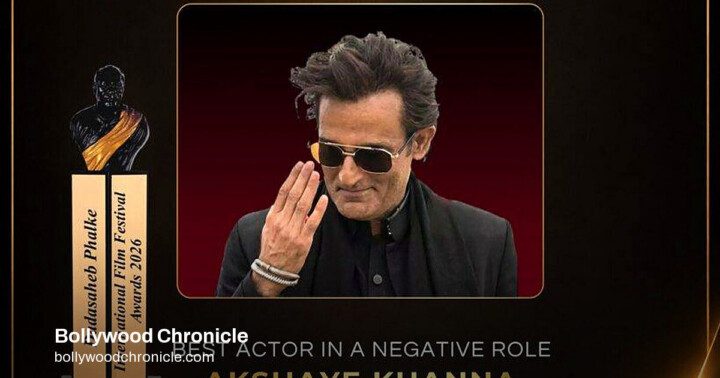
Akshaye Khanna has won the Best Actor in a Negative Role award at the Dadasaheb Phalke International Film Festival Awards 2026 for his performance in Dhurandhar. The festival, named after Indian cinema pioneer Dadasaheb Phalke, announced the recognition on its official Instagram channel. The Mumbai ceremony is scheduled for 20 November 2026.
What the festival is recognising
The announcement is notable for the language it uses. DPIFF highlighted Khanna’s “command over the character” and his “ability to convey intensity” in the role. That points to a judgement about craft, not just the actor’s ability to appear threatening on screen.
An effective antagonist is rarely defined by volume or villainy alone. The most durable negative performances often depend on restraint, psychological detail and an inner logic that lets the audience understand the character without endorsing the character’s conduct.
- Restraint over excess: making a character credible without reducing the part to simple villainy.
- Stakes and tension: a layered opposing force raises the dramatic pressure on the protagonist.
- Inner logic: the audience can follow the character’s reasoning even when rejecting the conduct.
Why a separate category matters
Negative-role awards make visible a kind of screen work that is often discussed only in relation to the lead narrative. An antagonist can be the source of conflict, a reflection of the protagonist, or a representation of the social and moral pressures the story explores. Celebrating that work broadens the conversation about what makes a film performance impactful.
For viewers, the category is an invitation to watch a performance as a structural element: how the actor sets the stakes, introduces threat, and gives the central conflict its weight. That is a different question from whether the character is likeable—and a more useful one for understanding a film’s emotional machinery.
What it gives Dhurandhar
The award also draws attention to Dhurandhar itself. Jio Studios and B62 Studios are associated with the project, and the recognition gives the film’s cast, creative team and production ecosystem an additional reason to be part of the pre-ceremony conversation.
Beyond that, the announcement keeps the specifics deliberately narrow. DPIFF’s note advises audiences to treat details about the film as confirmed only when they come from the filmmakers or authorised production sources. That is the correct posture for a project whose full release details and narrative elements have not been independently outlined in the award notice.
The category’s place in Hindi cinema
Villainous figures have long been central to Hindi film storytelling, often carrying the ideological stakes that the hero must contest. But recognition for that work as a formal category—rather than as part of a broad supporting performance field—gives it a distinct measure of prestige. It asks audiences to consider what the performer is doing technically, and to separate the quality of the acting from the moral position of the role.
For Dhurandhar, the award is a point of interest ahead of the Mumbai ceremony and a reason to look closely at how the film uses its antagonistic character to build tension and dramatic momentum. For Khanna, it puts a specific performance into the 2026 awards record in a way that is hard to reduce to a passing mention.
Source: Dadasaheb Phalke International Film Festival – DPIFF

Comments