

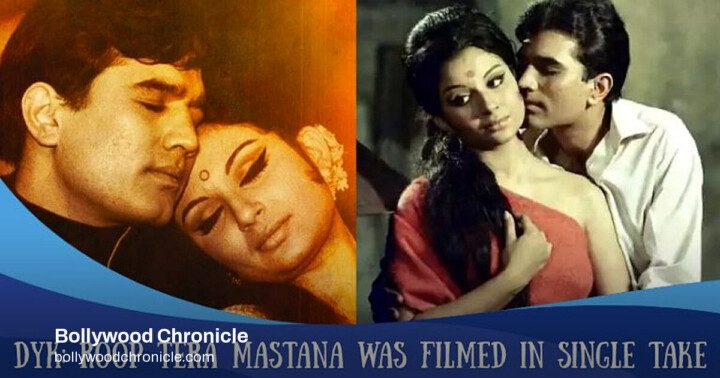
One take, no edits
When Aradhana released in 1969, its romantic song picturisations quickly became a reference point. Roop Tera Mastana sits at the top of that list for a specific reason: the entire sequence was filmed as one continuous shot. According to accounts of the shoot, the set had to be cleared, which meant Rajesh Khanna and Sharmila Tagore had a single pass to complete it.
The full romantic sequence runs about three minutes. With no cuts to rescue a stumble, the two actors had to stay in character through every movement, glance and expression. A conventional song shoot can be covered from several angles and reassembled in the edit; this one could not.
Why the constraint shows on screen
The interesting part is that the finished sequence betrays none of that pressure. It reads as easy, fluid and intimate—exactly the effect a good single take can produce. The uninterrupted frame keeps the camera close to the performers and lets the song breathe without cutting away.
The song’s craft ran deeper than the visuals. S.D. Burman composed it, Anand Bakshi wrote the lyrics and Kishore Kumar sang it. Together with the picturisation, those elements helped make Roop Tera Mastana among the defining romantic songs of Hindi cinema.
What the legacy teaches
The track has not been left in the past. In 2020, Mika Singh released a remix featuring Giorgia Andriani, a signal that the song still carries currency with a new generation. But the original remains the benchmark, partly because of how it was made.
For readers who follow Hindi cinema’s history, the story is a small framework for watching classics:
- The full song was shot without any edits or cuts.
- The set had to be cleared, so retakes were not practical.
- The ease on screen was earned in a single, unbroken pass.
The takeaway for creative work is just as direct: removing the safety net can sharpen a performance. When you cannot fix it later, you commit to it fully. That is what the sequence demanded, and what it still rewards on every rewatch.
Source: Bollywood Bubble

Comments