

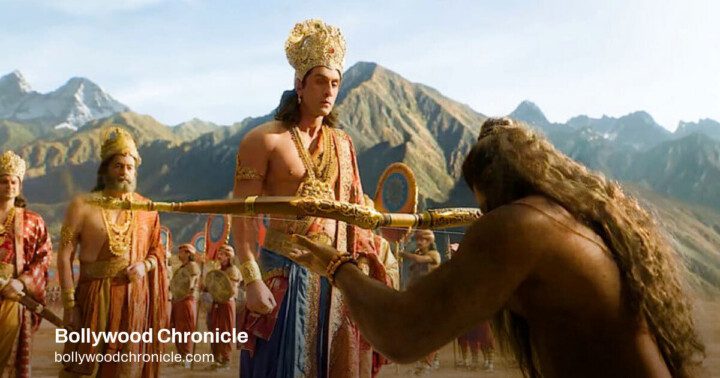
Ramayana: Rise of a Legend opened worldwide on Thursday as Indian cinema’s most expensive attempt yet to turn a foundational Sanskrit epic into a mainstream global event. Producer Namit Malhotra told AFP that the project is “the largest production in the history of Indian cinema,” with a reported combined budget of US$420 million (S$537 million).
An Indian story with Hollywood machinery
The two-part spectacle casts Ranbir Kapoor as Rama, Yash as Ravana and Sai Pallavi as Sita under director Nitesh Tiwari. The story follows Rama’s battle to rescue Sita from Ravana, rendered with flying elephants and large-scale VFX.
Malhotra’s visual effects house DNEG has eight Academy Awards, and the score comes from Hans Zimmer and AR Rahman. Sony Pictures is handling international distribution.
That is the strategic break: the film was shot entirely in Hindi, then a separate English master version was built using cast and voice artists with lip-syncing. It has an English cut of nearly three hours, while consciously dropping the elaborate song-and-dance routines often associated with Bollywood.
Why it matters
Indian cinema already produces around 2,000 films a year and finds wider audiences through diaspora networks and streamers such as Netflix and Amazon Prime Video. But the industry has so far not won in the major Oscar categories, and Hindi films rarely open as global events at this scale.
Malhotra has branded the film India’s Star Wars or Lord of the Rings. For close followers of Hindi cinema, the test is not whether the visual scale is large; it is whether an authentically Indian telling, with Hollywood production muscle and an English version, can hold non-Indian audiences without diluting its source.
Yash called the release “a very important moment” for Indian cinema and said East and West had come together “in a true sense.”
What to watch for
- Compare the Hindi and English versions: the Hindi cut carries the original performances; the English master is a deliberate global translation, including lip-synced dialogue.
- Watch the song-and-dance absence: the film keeps melodrama, romance, action and a near three-hour runtime but strips the traditional musical grammar.
- Track the global opening: early international numbers will signal whether the two-part global strategy is sustainable or a one-film spectacle.
Sai Pallavi said the hardest part was silencing “every part of you that wants to overperform” and letting the character speak for itself. It is the right test for the film itself: the Ramayana already carries its own weight; the question is whether the global machinery amplifies it rather than overwhelms it.
Source: Channel NewsAsia

Comments