

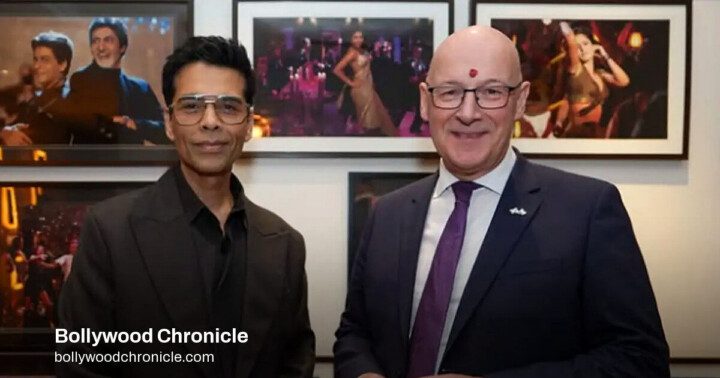
Scotland’s First Minister John Swinney took his screen pitch to one of Hindi cinema’s most visible addresses this week, meeting Karan Johar and Dharma Productions CEO Apoorva Mehta in Mumbai.
The meeting placed a politician, a filmmaker and an industry body in the same conversation, with Scotland making a direct case for a long-term screen partnership with Indian film and television.
The visit was part of Scotland’s ongoing effort to strengthen creative ties with Indian cinema. Screen Scotland joined the discussion and argued for the country as a shooting destination, citing skilled crews, high-quality infrastructure and creative expertise.
A pitch built on memory
For Johar, the meeting carried a personal register. In an Instagram post, he described the visit as an “honour” and said it took him back to Kuch Kuch Hota Hai, where some of the film’s sequences were shot against Scottish backdrops. He added that the conversation moved from those memories to a wish to “deepen the friendship between the two countries in the cinematic field.”
The nostalgia is not incidental. Kuch Kuch Hota Hai is part of Hindi cinema’s visual memory, and Scotland’s appearance in it gives the country a reference point no brochure can manufacture. A film commission that can attach a location to a beloved film is no longer selling geography; it is selling continuity.
What was discussed
- Scotland’s potential as a filming destination for future Indian film and television productions.
- Scotland’s stated strengths: skilled crews, high-quality infrastructure and creative expertise.
- A Producers Guild of India roundtable to explore a long-term screen partnership.
The inclusion of the Producers Guild of India is the substantive signal. Ministerial visits produce photographs; industry roundtables produce relationships, and relationships eventually become permits, locations and production spend. That senior Indian producers and Scottish screen-sector representatives sat together suggests Scotland is not chasing a single project but a pipeline.
Why it matters for Hindi cinema
International film commissions have long treated Hindi cinema as a growth market: its productions travel, its song sequences turn landscapes into icons, and audiences respond to foreign backdrops. Scotland is now making that case with an additional asset—a shared cinematic past.
The practical test will be what follows. Incentives, logistics, budgets and co-production clarity will matter more than a fond memory. For any film board or marketer, the lesson is to lead with the shared memory and move quickly to commercial detail. Make nostalgia the invitation, not the argument.
Source: Mid-day

Comments