

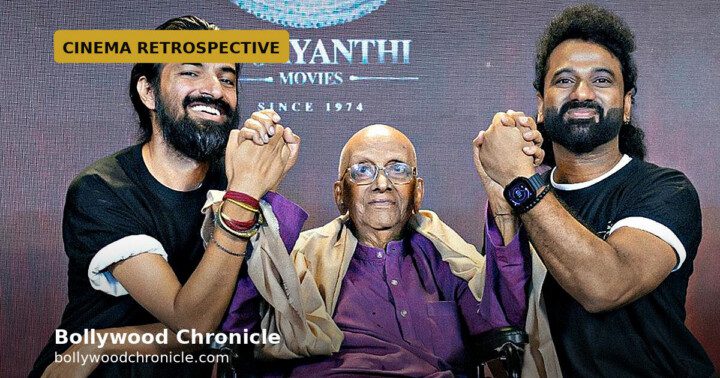
Singeetham Srinivasa Rao spent his final days doing what he had done for more than seventy years: writing for the big screen. The last message the filmmaker sent Nag Ashwin, dated September 5, 2026, was not a farewell but a title for a new project—”A fruit cuts the knife.” Ashwin shared the line on social media soon after news of Rao’s death at 94.
A career spent solving puzzles
Rao never had much interest in the fixed grammar of commercial cinema. In a 2013 interview, he described his preferred material plainly: “I like my films to be like a puzzle, which I can solve while making. Films that have a set format with four songs and a few comedy scenes have never interested me.”
That instinct ran through a filmography that crossed languages and genres—Raaja Paarvai, Bhairava Dweepam, Aditya 369, Apoorva Sagotharargal, Mayuri, Michael Madana Kama Rajan and Pushpak among them. He made science fiction playful, and he conjured Kamal Haasan’s dwarf act in Apoorva Sagotharargal long before visual effects could do the work. Imagination and technique had to be enough.
The “Why not?” filmmaker
The clearest statement of method was Pushpak, the 1980s silent film. When Suhasini Mani Ratnam asked him why he wanted to make a film without dialogue, Rao’s answer was simple: “Why not?” It was the same conviction with which he shot Welcome Obama on Eastman Color in 2013, while the industry had already moved to digital, and refused makeup for his actors because he wanted skin texture and colour to look real.
Sing Geetham’s forty-year wait
His final release, the June 2026 Telugu musical Sing Geetham, had been conceived nearly forty years earlier. Set in the fictional village of Kuberapuram, it turns on the last surviving tree after greed has broken the ecological balance, and its dialogue is sung. Several producers passed before Vyjayanthi Films—through Nag Ashwin and sisters Swapna and Priyanka Dutt—backed it.
The film landed after a dull summer in which Telugu cinema had drawn nearly a blank at the box office, and it arrived as a deliberate fresh breath. Even during a health setback on set, Rao stayed engaged with co-director Sankalp Gora and the young writers executing his vision.
The generation he shaped
Rao’s influence sits inside a lot of current Indian cinema. He began as an assistant director to K.V. Reddy on Maya Bazar, and he later helped Nag Ashwin sharpen a key sequence in the Savitri biopic Mahanati by suggesting the drama of a broken glycerine bottle. Prasanth Varma consulted him before making Awe, and took away the advice to follow his heart rather than wait for stars. Vivek Athreya called him “the Indian Steven Spielberg for my generation.”
These are useful reminders for Hindi cinema too. The lesson is not that every film should abandon dialogue or shoot on film. It is that a director’s refusal to accept a default template can become the film’s identity. He put it in his own way: “When I am making a film, I feel like I am on a holiday.”
Source: The Hindu
Comments